
Friday Notes, April 8, 2022
Dear Friends –
Did you miss me during the past two weeks? I certainly missed writing Friday Notes, but my brain has been too saturated by the experience of being in Rabat, Morocco, and Dakar, Senegal, to be able to commit any thoughts to paper. Now that I’ve been back for almost a week, it’s time for a couple of reflections.
As was the case last November, when I had the chance to travel for the first time to IDinsight offices in Nairobi and Lusaka, meeting my colleagues in their work settings was revelatory. This was in part because of difference: between countries with histories of entanglement with the British (Kenya, Zambia) and the French (Morocco, Senegal), and between the two Francophone countries themselves. And in part it was enlightening because of the same-ness: there is a signature energy and spirit, a raw brilliance, that I have found in each of the IDinsight offices. If there is a cynical person at this organization, I have yet to find them.
I’ve been to Senegal several times before, but never taken the time for anything resembling tourism. This time, with one unscheduled Sunday, I arranged to go to Gorée Island. A short ferry ride from Dakar, and small enough to walk around in an afternoon. Gorée is well known as one of the westernmost sites in Africa – and, consequently, one of the important locations in this history of slavery.
The details about Gorée’s role in the African slave trade is the subject of considerable debate among historians. Some say it played only a minor role in transporting slaves between the 15th and the 19th century and that there’s been myth-making to bump up its tourism appeal. Others claim it was the largest slave-trading center on the African coast. Sequentially under the control of Portugal, the Netherlands, England, and France, it is said to be the departure point for harrowing journeys to Brazil, the West Indies, and the southern United States.
Without any qualifications to enter into the fray, I’m going to choose to believe what the signs and my guide said – firmly on the side of “this is the place where it happened.” But it’s possible that we need a figurative rather than a literal understanding, and the island may be a symbol of what happened in many places on the west coast of Africa.
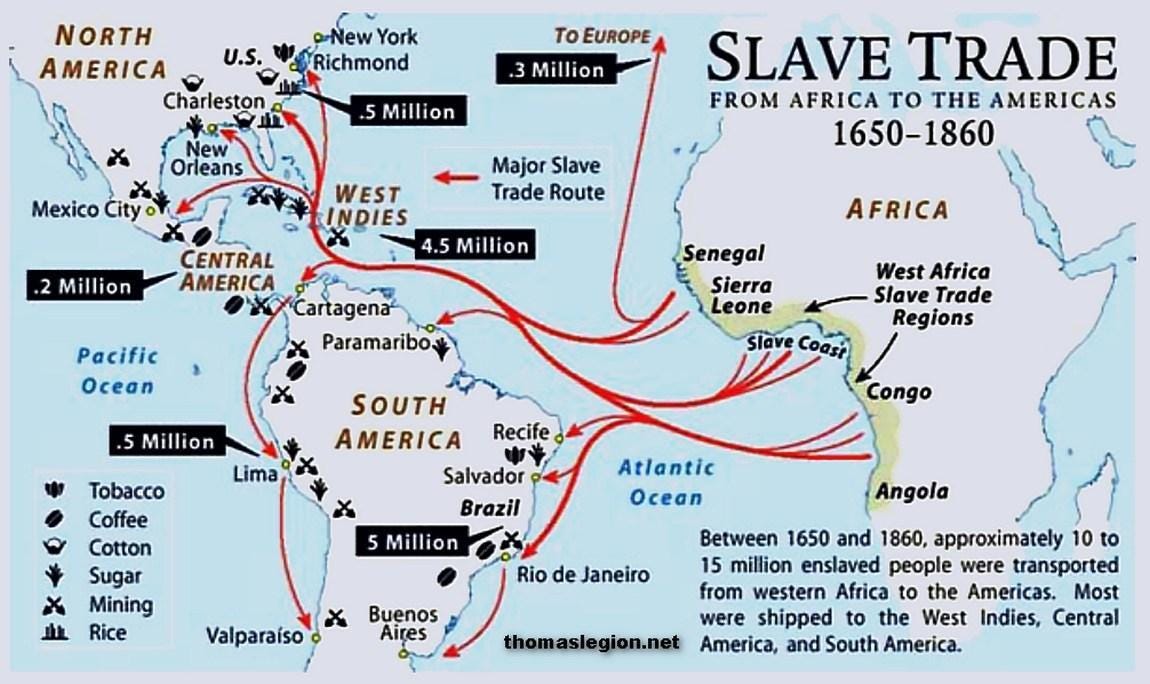
On the island, many of the original buildings are preserved, including the House of Slaves, built in 1776: downstairs, spaces that would have been inhumanly crowded with men, women and children, designed for misery and the spread of disease; upstairs, relatively luxurious accommodations for the slave traders. In glass cases, examples of the guns, mirrors, and trinkets that Europeans brought to African leaders in exchange for slaves. On the water’s edge is the “Door of No Return,” through which slaves were said to have embarked on ships carrying up to 700 people in the most squalid conditions imaginable. (This visualization of the slave trade depicts the magnitude, whether from Gorée or not.) The House of Slaves is a small building that holds an infinite number of questions.
Being on Gorée Island was moving in a way that books, podcasts, and photographs just cannot be – again, even if it’s not literally the site of all the events claimed. It is, properly, a “site of conscience,” preserved to remind us of what people are capable of. I mean the harms and dehumanization that people are capable of perpetrating. And, on the other side, I mean the sheer force of will that must have been present in people who were treated so badly but survived, built families, and maintained hope that their children, grandchildren, and great-grandchildren would be free in all the meanings of that word.
Beyond thinking about the best and the worst of the human race (which might have been enough for one afternoon), there was a lot the experience at Gorée had to say about “development.” Most of us, I’d wager, think about Portugal, the Netherlands, England, France, and the United States as “developed.” We also think about, say, Senegal, the Gambia, Cape Verde, and other slave-sending countries in Africa as “developing.” From the vantage point of Gorée Island, though, it is impossible to miss the fact that extraction and exploitation have been the foundation of “development.” You know it, you read it, and sometimes – as was the case for me on Gorée – you really feel it.
It truly is possible to build relationships purely via videoconferencing, but there are some collegial interactions that only happen when you’re physically together. On this trip, for instance, I had the chance to observe and participate in a lunchtime conversation that started with complaints about traffic and ended up being about how inequality is expressed in urban spaces. Around the table were colleagues from Bogota, Nairobi, Dakar, Chicago, Rabat, Gaborone, Amsterdam, Kigali, and a small city in the English-speaking part of Cameroon, each able to describe and analyze the distance between rich and poor in the places they were from.
It was the sort of lively, eye-opening conversation that happens only when the space is created for it, and people choose to bring the gift of their presence. (The discussion reminded me a lot of these amazing drone shots of urban inequality around the world.) I wanted to have lunch with these guys every day.
* * *
If you followed the confirmation hearings for Justice Ketanji Brown Jackson, you might have heard Senator Cory Booker quote the Langston Hughes poem “Let America be America Again.” It’s very much worth reading in its entirety, so here I’m pasting it below.
Have a good weekend,
-Ruth
Let America Be America Again
Langston Hughes - 1901-1967
Let America be America again.
Let it be the dream it used to be.
Let it be the pioneer on the plain
Seeking a home where he himself is free.(America never was America to me.)
Let America be the dream the dreamers dreamed—
Let it be that great strong land of love
Where never kings connive nor tyrants scheme
That any man be crushed by one above.(It never was America to me.)
O, let my land be a land where Liberty
Is crowned with no false patriotic wreath,
But opportunity is real, and life is free,
Equality is in the air we breathe.(There’s never been equality for me,
Nor freedom in this “homeland of the free.”)Say, who are you that mumbles in the dark?
And who are you that draws your veil across the stars?I am the poor white, fooled and pushed apart,
I am the Negro bearing slavery’s scars.
I am the red man driven from the land,
I am the immigrant clutching the hope I seek—
And finding only the same old stupid plan
Of dog eat dog, of mighty crush the weak.I am the young man, full of strength and hope,
Tangled in that ancient endless chain
Of profit, power, gain, of grab the land!
Of grab the gold! Of grab the ways of satisfying need!
Of work the men! Of take the pay!
Of owning everything for one’s own greed!I am the farmer, bondsman to the soil.
I am the worker sold to the machine.
I am the Negro, servant to you all.
I am the people, humble, hungry, mean—
Hungry yet today despite the dream.
Beaten yet today—O, Pioneers!
I am the man who never got ahead,
The poorest worker bartered through the years.Yet I’m the one who dreamt our basic dream
In the Old World while still a serf of kings,
Who dreamt a dream so strong, so brave, so true,
That even yet its mighty daring sings
In every brick and stone, in every furrow turned
That’s made America the land it has become.
O, I’m the man who sailed those early seas
In search of what I meant to be my home—
For I’m the one who left dark Ireland’s shore,
And Poland’s plain, and England’s grassy lea,
And torn from Black Africa’s strand I came
To build a “homeland of the free.”The free?
Who said the free? Not me?
Surely not me? The millions on relief today?
The millions shot down when we strike?
The millions who have nothing for our pay?
For all the dreams we’ve dreamed
And all the songs we’ve sung
And all the hopes we’ve held
And all the flags we’ve hung,
The millions who have nothing for our pay—
Except the dream that’s almost dead today.O, let America be America again—
The land that never has been yet—
And yet must be—the land where every man is free.
The land that’s mine—the poor man’s, Indian’s, Negro’s, ME—
Who made America,
Whose sweat and blood, whose faith and pain,
Whose hand at the foundry, whose plow in the rain,
Must bring back our mighty dream again.Sure, call me any ugly name you choose—
The steel of freedom does not stain.
From those who live like leeches on the people’s lives,
We must take back our land again,
America!O, yes,
I say it plain,
America never was America to me,
And yet I swear this oath—
America will be!Out of the rack and ruin of our gangster death,
The rape and rot of graft, and stealth, and lies,
We, the people, must redeem
The land, the mines, the plants, the rivers.
The mountains and the endless plain—
All, all the stretch of these great green states—
And make America again!